
More than 18 months after Tropical Storm Helene hit western North Carolina, housing remains a critical component of the recovery and the effort to increase resiliency. The damage to housing in the state’s US Department of Housing and Urban Development’s (HUD) Most Impacted and Distressed (MID) counties[i] was estimated at $13.5 billion[ii]. While new construction is helping in rebuilding the 16-county region, permitting has slowed from the pre-Helene pace and is uneven across these most impacted western NC counties.
Before Helene, housing availability and affordability was a priority across the impacted counties. A June 2024 Asheville City Council Affordable Housing Plan projected a need of 14,000 new housing units in Asheville alone to keep up with population growth over the next ten years. Using pre-Helene data, Transylvania County's 10-Year Affordable Housing Strategy projected another 1,500 additional housing units were needed. Additionally, 28% of households in the 16 MID counties were housing cost burdened prior to Helene, paying more than 30% of their income on housing costs. This figure is 50% for the region’s low-income households[iii].
Helene’s housing impacts were layered on top of these already challenging housing needs. Statewide, Helene was estimated to have damaged or destroyed as many as 73,000 homes. Drilling down to the most impacted counties (federal and state designated), damage was widespread, with roughly 1,000 homes completely destroyed and several thousand more with major damage (Figure 1).
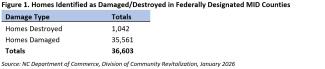
With this storm-related housing loss occurring against a backdrop of an already difficult housing market, it is useful to formulate an early picture as to how rebuilding and new housing efforts are going. HUD publishes building permit data at the county level, allowing a window into building activity in the federally designated MID counties. Building permits can capture a couple of post-Helene happenings: the rebuilding of homes that were destroyed or suffered major damage in the storm and new residential construction, both critical to the region’s recovery.
Examining HUD residential building permitting data[iv] for the 12 months pre- and post-Helene provides a comparative picture of overall building activity initiated. During this time (October 2023–September 2024 to October 2024–September 2025), preliminary building permitting totals show that the MID counties, as a region, are trending similarly to the state as a whole, with both seeing an 18% decline. Multi-family permitting in the impacted MID counties dropped by 31% and single-family permitting dropped by 9%. With Helene having destroyed or severely damaged over 3,000 homes, this decline in permitting leaves the region both without the production needed for existing needs but also without the short-term compensatory boost in housing production necessary to support full recovery.
County-level data shows some exceptions to this larger trend. See Figure 2 below. Four MID counties had an overall increase in units permitted (the combined total for single family and multi-family) and five counties saw an increase in single family unit permitting.
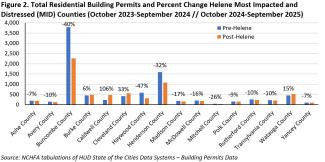
There are a few bright spots at the county level. Watauga County saw an uptick in multi-family permitting, with 286 units on deck in the 12 months following Helene compared to 44 units in the 12 months before Helene. In Caldwell County, single family permitting, more than doubled, increasing from 226 permits pre-Helene to 475 post-Helene. A multi-family shift in post-Helene Cleveland County shows an increase in tri- and quad-plex permitting.
Building permit data is a good early indicator for what housing may become available in the next one to three years. There is some lack of precision in that some permits never ultimately produce completed units and there is a wide variation of length of time from permit to completion. However, permits serve as a tool in predicting near-term housing solutions and the gaps that can be anticipated. The permitting activity shows where recovery in the region is taking shape to address ongoing as well as housing needs related to Helene and where the pace of construction may need to accelerate to ensure a successful recovery.
The NC Housing Finance Agency is supporting the recovery of impacted counties with new rental units leasing up from previous investments and additional prioritization of Helene-impacted areas in upcoming program awards. To learn about the Agency’s range of efforts to address housing affordability in the western impacted counties and across the state, visit https://www.nchfa.com/.
----------------
[i] US Department of Housing and Urban Development designated MID counties are: Ashe, Avery, Buncombe, Burke, Caldwell, Cleveland, Haywood, Henderson, McDowell, Madison, Mitchell, Polk, Rutherford, Transylvania, Watauga, and Yancey. One ZIP code in Mecklenburg County is also included in this MID area, but based on lack of ZIP code specific permit data, is not included in this discussion.
[iii] NC Housing Finance Agency analysis of 2023 1-year Public Use Microdata Sample (PUMS) data and 2021 5-year Comprehensive Housing Affordability Strategy (CHAS) data. Household income groups were calculated using 2023 HOME income limits. The number of households living in unaffordable homes is estimated using PUMS data, which is available at the Public Use Microdata Areas (PUMA) geography. PUMAs are non-overlapping areas containing no fewer than 100,000 people each. Given these population thresholds, in rural areas, multiple counties often make up a single PUMA. When multiple counties are located in a single PUMA, the data associated with each PUMA has been proportionally distributed to each county based on county-level data from the 2021 5-year CHAS data available through HUD.
[iv] State of the Cities Data Systems – Building Permits – October 2023 – September 2025, retrieved on March 10, 2026; https://www.huduser.gov/portal/datasets/socds.html.